01/01/2026
White‑label card solution (co‑branded cards)
Wallester is an Estonian fintech founded in 2016 that has become a principal member of Visa. Since launching its card products, the company has offered two complementary solutions: a white‑label card issuing programme that lets businesses issue branded payment cards, and a Wallester Business platform with IBAN account, cards and expense management, which will be released in March 2026 in a package designed for freelancers. This study analyses these two solutions, their features and their advantages compared with competitors.
Context and definition
White‑label card programmes allow non‑bank companies to issue branded cards without holding their own licence or payment infrastructure. Wallester, a principal Visa member with a European licence, acts as the issuer, handles regulatory compliance and connects to payment schemes. This approach meets the growing demand for embedded finance solutions, particularly in e‑commerce and platform economies.
Wallester’s white‑label programme offers a complete toolkit to launch Visa physical or virtual cards quickly: the client chooses the design, sets spending rules and manages cards via APIs or a web portal. Services include KYC/AML compliance, tokenisation for Apple Pay/Google Pay, 3D Secure, dynamic spending controls and anti‑fraud tools. Wallester also provides a dedicated BIN (card identifier) and a white‑label mobile app for cardholders.
How it works and benefits
Rapid and flexible issuance. Wallester is part of Visa’s FinTech Fast Track programme. The company handles the entire process (legal, design, manufacturing), enabling businesses to launch digital cards in about one month and physical cards in three months. Cards can be tokenised and immediately added to mobile wallets.
Full card control. The programme gives businesses full control over card logic: per‑card or programme‑wide limits, merchant or category restrictions and real‑time authorisation rules. The API‑first architecture makes it easy to integrate card management into existing applications and systems.
Compliance and security. Wallester handles compliance across Europe, including KYC/AML screening, 3D Secure, tokenisation and fraud monitoring. The solution is PCI DSS level 1‑certified and maintains uptime above 99.5 %.
Customisation and branding. Companies can choose cards made from PVC, metal or alternative materials, add their logo and create integrated loyalty programmes. Finextra notes that Wallester offers an unlimited number of Visa cards under one contract, localised wallets for more than 25 EEA countries and the option to create metal cards for a premium experience. Users access their balance and transactions through the white‑label app.
Integrations and support. Wallester provides REST APIs and code samples. An integrated CRM processes payments in real time, making the solution suitable for gig‑economy platforms (Uber, couriers, etc.). The fintech also offers a client portal, SDK and technical support.
Use cases
Wallester positions its solution across many sectors. The official site mentions consumer lenders, peer‑to‑peer lending platforms, banks and fintechs, travel agencies and online travel agents, e‑commerce marketplaces, gift and loyalty programmes, gig‑economy employers and insurance companies. In practice, the solution allows:
lending platforms to issue cards to withdraw funds directly from customer accounts;
travel agencies and marketplaces to provide payment cards for refunds and loyalty;
gig‑economy companies (ride‑hailing, on‑demand delivery) to pay workers via a card that automatically reloads;
loyalty programmes to boost engagement by offering co‑branded cards with discounts.
Comparison with other issuers
The European white‑label card issuing market is highly competitive. A January 2026 study by SDK Finance lists Wallester alongside Galileo, SynapseFI, SolarisBank and Bond as leading platforms. The study highlights that Wallester offers a regulated infrastructure in Europe, enabling companies to issue virtual and physical Visa cards with full control, customisable limits and API‑based integration.
Finextra’s May 2025 overview of the five main European white‑label card issuers notes that Wallester is licensed by the Estonian Financial Supervision Authority and part of Visa’s FinTech Fast Track programme. Key advantages include the ability to issue an unlimited number of Visa cards, activate virtual cards instantly via API, provide localised wallets and customise metal cards.
By comparison, Marqeta (US) emphasises a highly configurable architecture with advanced authorisation controls and just‑in‑time funding to load a card at the moment of transaction—ideal for platform economies. Intergiro focuses on turnkey banking integration and rapid launch (a few weeks) while including account and currency management. Treezor, a French banking‑as‑a‑service provider, stands out by offering local IBANs, launch within 15 days and high‑volume processing.
Unlike these competitors, Wallester emphasises an all‑in‑one approach: providing a dedicated BIN, a client portal and a white‑label mobile app, combined with transparent pricing and technical support to simplify market entry. This combination makes it attractive for European fintechs seeking an integrated and compliant solution.
01/01/2026
Wallester Business offering for freelancers (available March 2026)
Overview of the offering
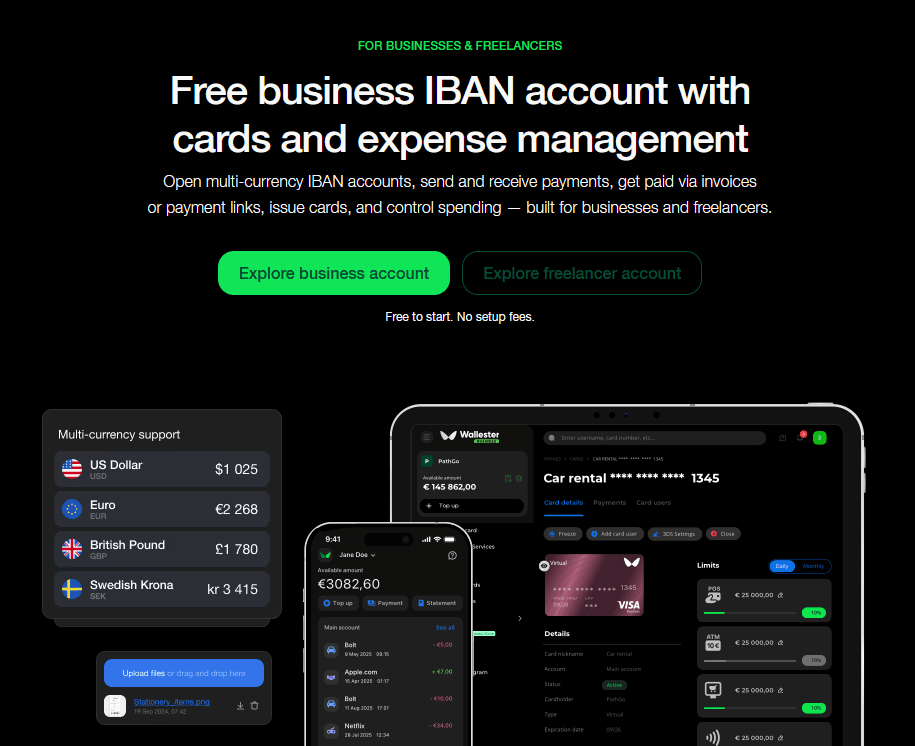
Wallester Business is a professional account with multi‑currency IBAN and cards designed for companies and freelancers. The official site states that the Business offering gives access to a free multi‑functional platform, including a business account in euros, issuance of 300 free virtual cards and an unlimited number of users without monthly fees. It offers Visa physical and virtual cards, compatibility with mobile wallets (Apple Pay, Google Pay, Garmin, etc.), multi‑currency support (EUR, USD, SEK, NOK, CZK, HUF, RON, GBP, PLN, DKK) and a user‑friendly mobile app to manage cards.
The Business page emphasises that the solution targets companies of all sizes and includes a real‑time dashboard, flexible parameters, instant card issuance, receipt attachment, custom spending limits and synchronisation with accounting software. The platform is PCI DSS level 1‑certified, a principal member of Visa and authorised by the Estonian financial supervision authority. It enables businesses to pay employees, remote team members or freelancers worldwide, perform batch payments and integrate payroll directly into accounting software.
A January 2026 blog post on Wallester highlights new features: direct integration with Xero and QuickBooks, 300 free virtual cards, a unified dashboard for tracking every transaction, tokenised cards compatible with Apple Pay/Google Pay, 24/7 currency exchange with 10 currencies, payroll and team cards allowing up to 1 500 transactions with one click, REST API access, BIN sponsorship to reduce declines and merchant whitelisting to avoid security checks. The offering has no subscription fees: users pay only for the services they use.
The review site Software Advice notes that “Wallester Business is a solution for companies and freelancers who want to streamline their financial processes by issuing corporate cards with an IBAN account”. Plans include a free option (0 €/month) that provides 300 virtual cards, unlimited physical card issuance, no maximum number of users and access to the REST API.
Payroll programme and freelancer management
To make it easier to pay freelancers and remote teams, Wallester offers the payroll card programme. A blog article explains that this programme is designed to give a better experience to employers, freelancers and affiliates. The process is simple:
Create a free Business account with KYC verification.
Invite payroll cardholders (freelancers, partners or employees) via the mobile app.
Cardholders receive an SMS link, complete verification via Onfido in under a minute and can generate virtual or physical cards.
The company can then make individual or batch payments from its portal, with no transfer commission.
Each card costs 1 € per month for the employer and can receive funds instantly after processing. Batch payments are executed via XML, Excel or CSV files, making it easy to export from accounting systems. This feature is particularly relevant for freelancers, who receive their fees on a Visa card and can spend their funds anywhere in the world thanks to the Visa network.
Integrations, multi‑currency and security
Wallester Business integrates accounting tools (Xero, QuickBooks, Sage, Oracle Netsuite) to automate expense entries and reconciliation. Users can export data in various formats and automatically sync transactions in their accounting software. Multi‑currency support (EUR, USD, SEK, NOK, CZK, HUF, RON, GBP, PLN, DKK) helps avoid costly conversions—an advantage for freelancers billing international clients.
Security is ensured by PCI DSS level 1 certification and the integration of 3D Secure and multi‑factor authentication for virtual cards, as highlighted by Software Advice users. In addition, Wallester is regulated by the Estonian financial supervision authority and Visa, guaranteeing clear fund segregation and legal protection.
Benefits for freelancers and comparison with other solutions
The forthcoming Wallester Business offering for freelancers, announced for March 2026, builds on these features and aims to provide independent workers with a professional account with no subscription fees, unlimited cards and the ability to get paid quickly by their clients via the payroll programme. Freelancers will be able to open an account online in a few hours, receive a virtual card immediately and then request a physical card. With multi‑currency support and transparent exchange, they avoid conversion fees when making international payments.
In France, several neobanks (Qonto, Finom, Revolut Business, N26 Business) also offer professional accounts. Comparisons highlight that some of these providers charge monthly subscriptions and limit the number of free cards. For example, the Finance Héros comparison notes that Wallester Business provides up to 300 free virtual cards for 0 €/month whereas other online banks charge subscription packages starting at 7 € to 29 € per month. This generosity regarding cards, combined with unlimited physical card issuance and no sign‑up fees, positions Wallester as a particularly suitable solution for freelancers managing multiple projects or clients.
Conclusion
Wallester stands out with its white‑label card issuing infrastructure and expense management platform, which will be offered in March 2026 in a version dedicated to freelancers. The White‑Label solution enables businesses to quickly launch branded Visa card programmes with full control, regulatory compliance and easy API integration.
The Wallester Business offering, originally designed for SMEs, includes a multi‑currency IBAN account, up to 300 free virtual cards, unlimited physical card issuance, a real‑time dashboard and accounting integrations. It will soon be adapted for freelancers to simplify invoicing and payment, thanks notably to the payroll card programme, batch payments and multi‑currency support.
By combining transparent pricing with great flexibility, Wallester positions itself as an innovative solution for European businesses and independent workers wishing to modernise their payment flows and benefit from a robust, customisable card infrastructure.

